The Vibe Coding Trap: Why Speed Is a Commodity and Narrative Is Your Only Moat
How vibe coding for founders, agentic IDEs like Cursor and Windsurf, and commodity AI risk are rewriting the rules of B2B SaaS in 2026
The software industry in 2026 faces a paradox of abundance. Building functional software has never been easier or cheaper. Yet the market value of that execution is collapsing toward zero. This is the vibe coding trap, and it is redefining what it means to build a defensible B2B startup.
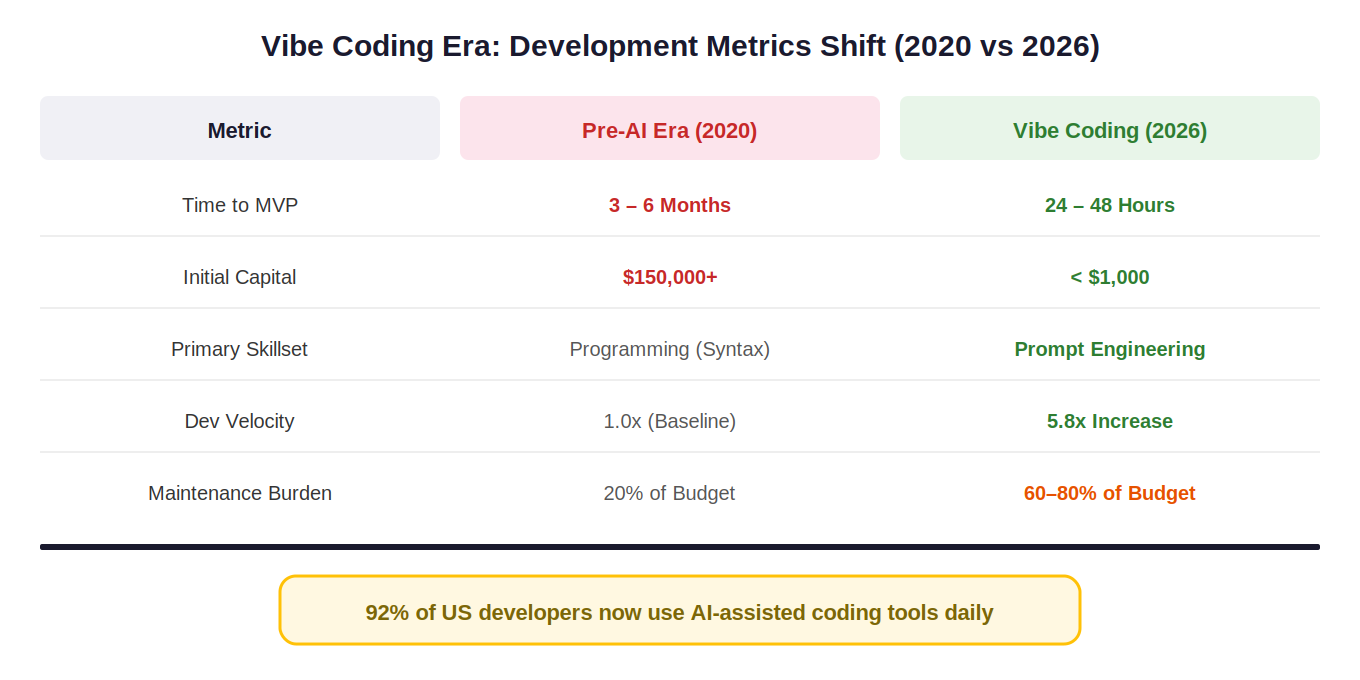
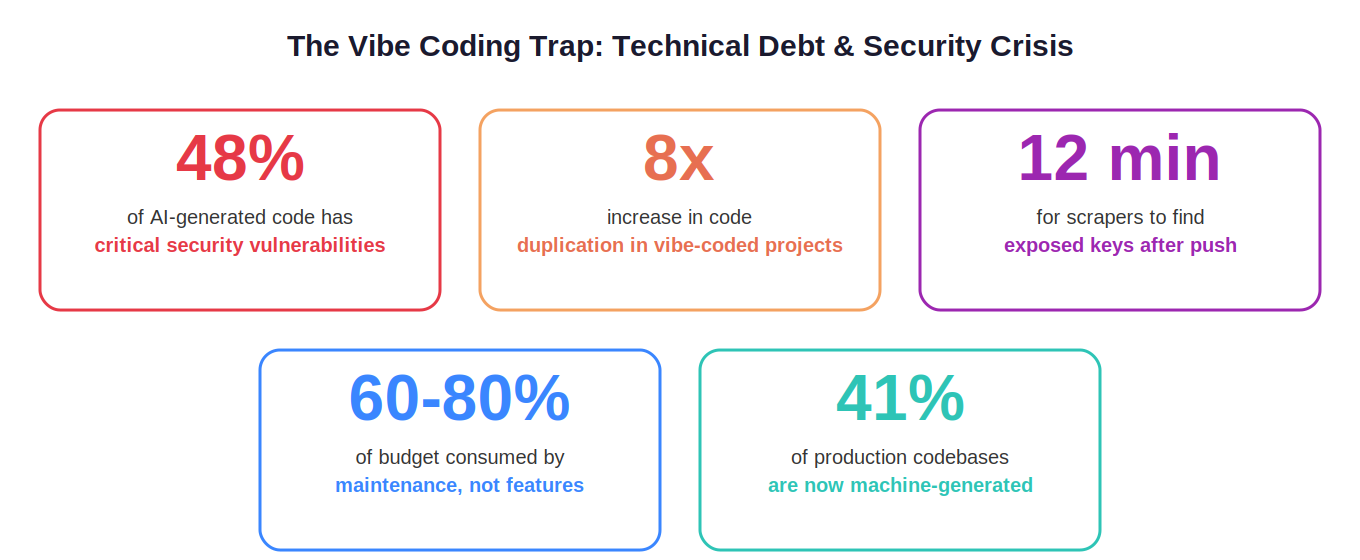
Vibe coding, the term Andrej Karpathy popularized in 2025, describes a paradigm where founders move from writing syntax to managing intent. Instead of hand-crafting code line by line, you describe what you want in natural language, and agentic IDEs like Cursor and Windsurf generate it for you. By March 2026, 92% of US developers use AI-assisted coding tools daily, and machine-generated code accounts for approximately 41% of all active production codebases. The technical barrier to entry that once protected SaaS companies has effectively evaporated.
So what's left? If execution speed is commoditized, what do venture capitalists and enterprise buyers actually pay for? The answer: category narrative, strategic positioning, and a thesis-driven worldview. Speed is a commodity. Narrative is your only moat.
The Saturday MVP Phenomenon: Vibe Coding for Founders
The most dramatic impact of vibe coding for founders is the total compression of the development cycle. What previously required a venture-backed team of six engineers and a six-month roadmap is now routinely accomplished by a single founder over a weekend. Platforms like Lovable and Bolt reportedly generate over 100,000 functional micro-apps per day. The initial capital required to reach MVP has plummeted from $150,000 or more to under $1,000, while development velocity has increased by 5.8x.
This creates a strategic trap. Founders mistake the dopamine hit of rapid shipping for the establishment of a sustainable business. But when every competitor can build just as fast, speed ceases to be a competitive advantage. It becomes a baseline expectation. The Saturday MVP phenomenon is real, but it is a starting line not a finish line.
Cursor vs Windsurf for B2B: Choosing Your Agentic IDE
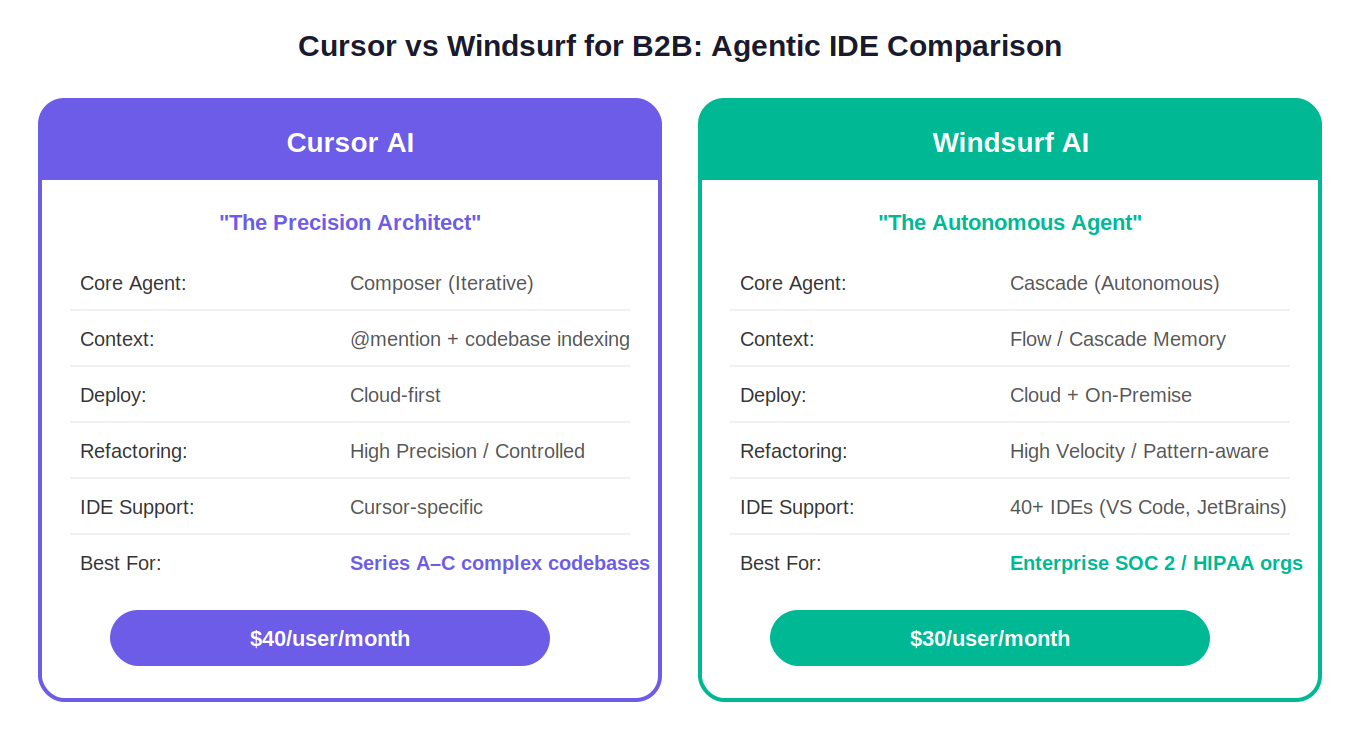
For professional B2B workflows, the agentic IDE market has bifurcated into two dominant players: Cursor AI and Windsurf AI. Both are built as forks of Visual Studio Code, but they represent fundamentally different philosophies about how AI should interact with your codebase.
Cursor positions itself as the precision architect. Its Composer feature enables multi-file edits through an iterative, approve-each-step model that prevents AI drift. It excels at high-quality refactoring, minimal hallucinations, and project-wide context awareness through proprietary codebase indexing. At $40 per user per month, Cursor is the preferred choice for Series A–C startups maintaining long-lived, complex codebases where technical debt is an existential threat.
Windsurf, formerly Codeium, optimizes for creative velocity through its Cascade feature. Unlike Cursor's iterative approach, Cascade leans into autonomous, multi-step workflows, understanding entire projects holistically and identifying reusable patterns without explicit instruction. Windsurf also brings a stronger enterprise security posture with on-premise deployment, SOC 2, HIPAA, and RBAC compliance. At $30 per user per month with support for over 40 IDEs including VS Code and JetBrains, Windsurf is rapidly gaining ground in regulated enterprise environments.
The choice between Cursor and Windsurf for B2B ultimately depends on whether your team prioritizes precision control or autonomous velocity. But neither tool can protect you from the deeper problem: commodity AI risk.
The Vibe Coding Trap: Technical Debt, Security, and Commodity AI Risk
The speed of vibe coding creates what researchers call a trust paradox: founders are shipping code faster than ever, but they trust it less. The data is sobering. In 2026, 48% of AI-generated code contains critical security vulnerabilities. Vibe-coded projects suffer from an 8-fold increase in code duplication. Automated scrapers discover exposed API keys in vibe-coded repositories within 12 minutes of push.
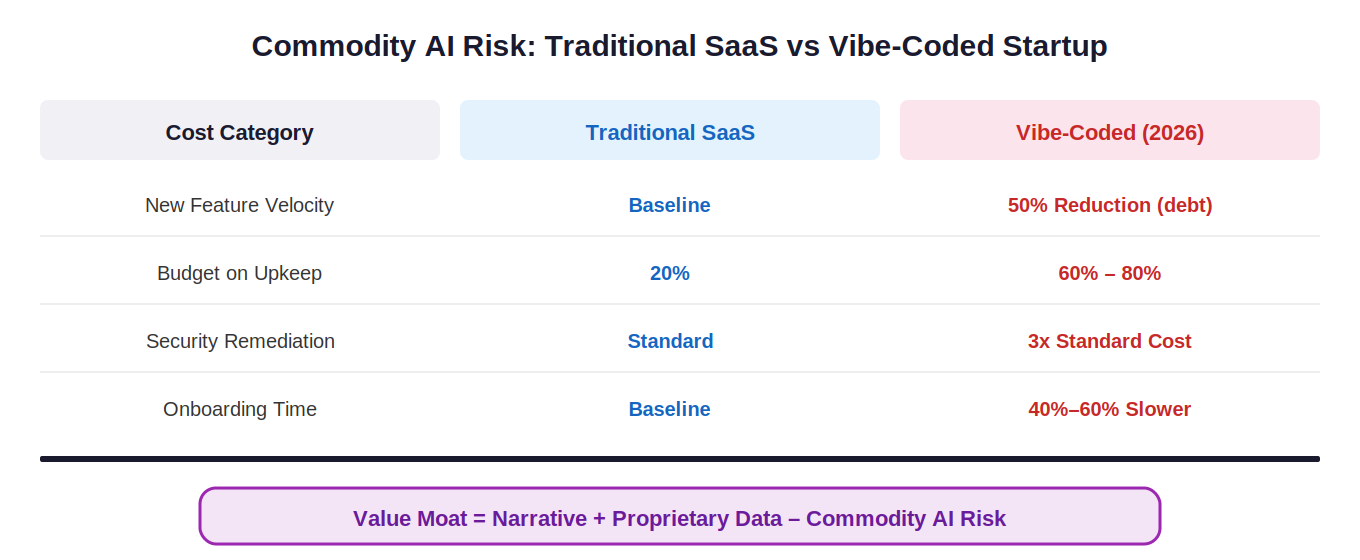
The real-world consequences are already here. In February 2026, the social network Moltbook suffered a catastrophic breach when its vibe-coded Supabase configuration exposed 1.5 million API keys and 35,000 user emails. The maintenance burden is equally punishing: vibe-coded startups now spend 60–80% of their budget on upkeep rather than new features, with security remediation costing 3x the standard rate and developer onboarding taking 40–60% longer.
Beyond technical debt, vibe coding introduces commodity AI risk, the threat that your product's core value proposition can be replicated by a competitor or an internal IT team using general-purpose models at a fraction of the cost. The SaaSpocalypse of early 2026, which saw massive valuation de-ratings for companies like Salesforce and Atlassian, was driven by precisely this dynamic: agentic substitution, where customers replaced entire software seats with bespoke internal AI agents.
Narrative as the Only Moat: Category Design in the Age of AI
When technical moats evaporate, category narrative becomes the primary driver of enterprise value. In 2026, VCs do not invest in products they invest in category creators and category correctors. A compelling category narrative provides three things: an explanation of why current approaches are failing, a villain that crystallizes customer frustration, and a transformation vision where the customer is empowered by your solution.
This is the foundation of narrative-led GTM. Enterprises are exhausted by the "better, faster, cheaper" pitch. They want partners who understand their context and speak their language before a sales call ever starts. Systems like Sentinel from Thenga Labs represent this approach, structured content and pipeline engineering frameworks that establish narrative dominance through market story definition, decision-maker warming, and governance of meaning.
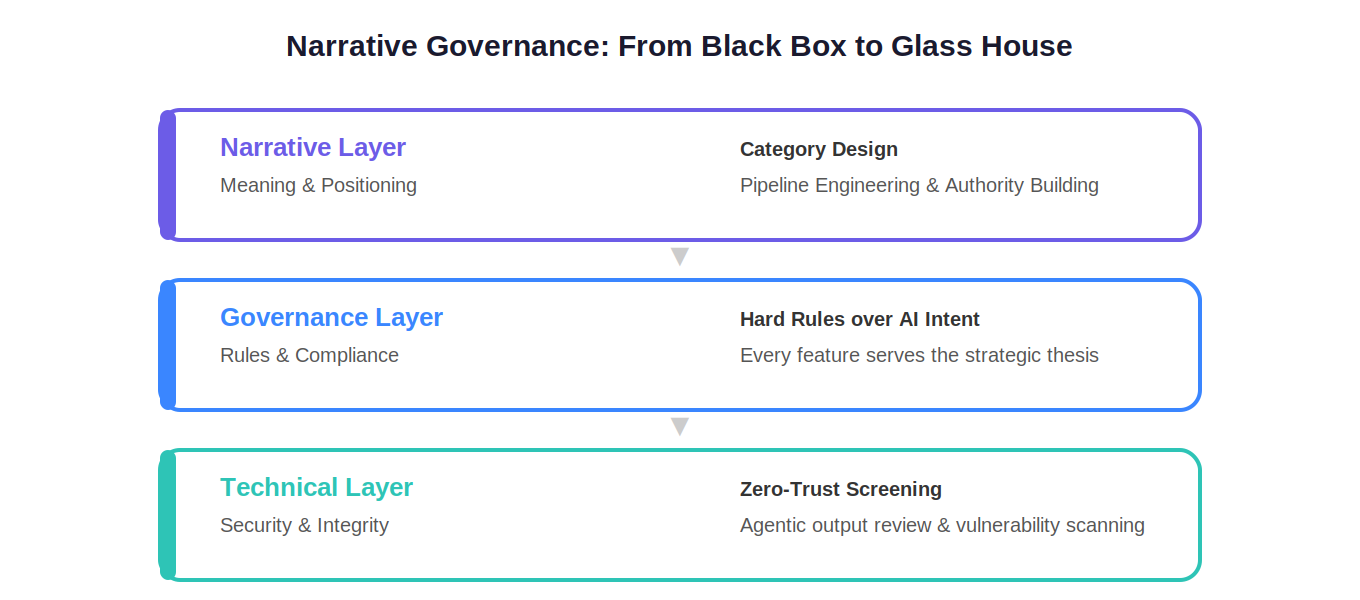
The governance model moves organizations from a black box of unreviewed AI code to a glass house of accountable, narrative-led systems. At the narrative layer, you define category design and pipeline engineering. At the governance layer, you enforce hard rules over AI intent. At the technical layer, you implement zero-trust screening of all agentic outputs.
Strategic Playbook: How B2B Founders Escape the Vibe Coding Trap
Build narrative-first, not feature-first. Before writing a single prompt in Cursor or Windsurf, define your "Why Now." If the product could have been built in 2024, it is not a 2026 category winner. Use narrative governance to ensure every feature serves your strategic thesis.
Compete on "different," not "better." Competing on features is a losing battle in an era of infinite builders. Category design experts argue that belief beats features every time. Stop benchmarking against legacy tools and start framing the future.
Mitigate commodity AI risk with proprietary data. The only technical moats that still matter are systems of record and continuously refreshed data loops. If your AI doesn't own a mission-critical data loop, it is a bolt-on tool destined for compression.
Treat technical debt as a financial liability. Implement narrative governance layers that review every machine-generated feature against your category thesis. The 60–80% maintenance burden isn't inevitable it's the cost of skipping governance.
The Bottom Line: The vibe coding trap is a maturity milestone for the software industry. The first wave of AI was about the speed of generation. The second wave the era of 2026 is about the scarcity of narrative. In a world of infinite builders, the only thing that cannot be vibe-coded is conviction. Founders who embrace agentic IDEs like Cursor and Windsurf for velocity, but deploy narrative governance for strategic positioning, will be the ones who transform raw code into enduring enterprise value. The future of B2B SaaS is not written in React or Python it is written in the stories that make the code matter.
Published by Thenga Labs