The MCP Revolution: Why Your AI Strategy Fails Without a "Context Protocol"
A Model Context Protocol (MCP) guide for B2B founders: why B2B AI data integration breaks today, how agentic workflow architecture depends on structured context, and what Anthropic MCP for enterprise means for your stack
Your company probably has AI. You have an LLM subscription. You have a copilot embedded somewhere in your product. You might even have a few AI agents running in production. But here's the uncomfortable truth that most B2B founders are discovering in 2026: having the "brain" doesn't mean you have intelligence.
The vast majority of enterprise AI implementations are failing silently. Not because the models aren't powerful enough they are but because those models are operating in the dark. They can't access your CRM data in real time. They can't pull context from last Tuesday's Slack thread. They can't cross-reference your Notion roadmap with your support tickets. They are powerful brains floating in a void, disconnected from the very business context that would make them useful.
This is the missing layer problem. And the Model Context Protocol MCP is the emerging standard designed to solve it. But here's what most companies get wrong: MCP alone isn't enough. Without structured context design, the protocol is just plumbing with nothing flowing through it.
The Missing Layer: Why Enterprise AI Stays Shallow
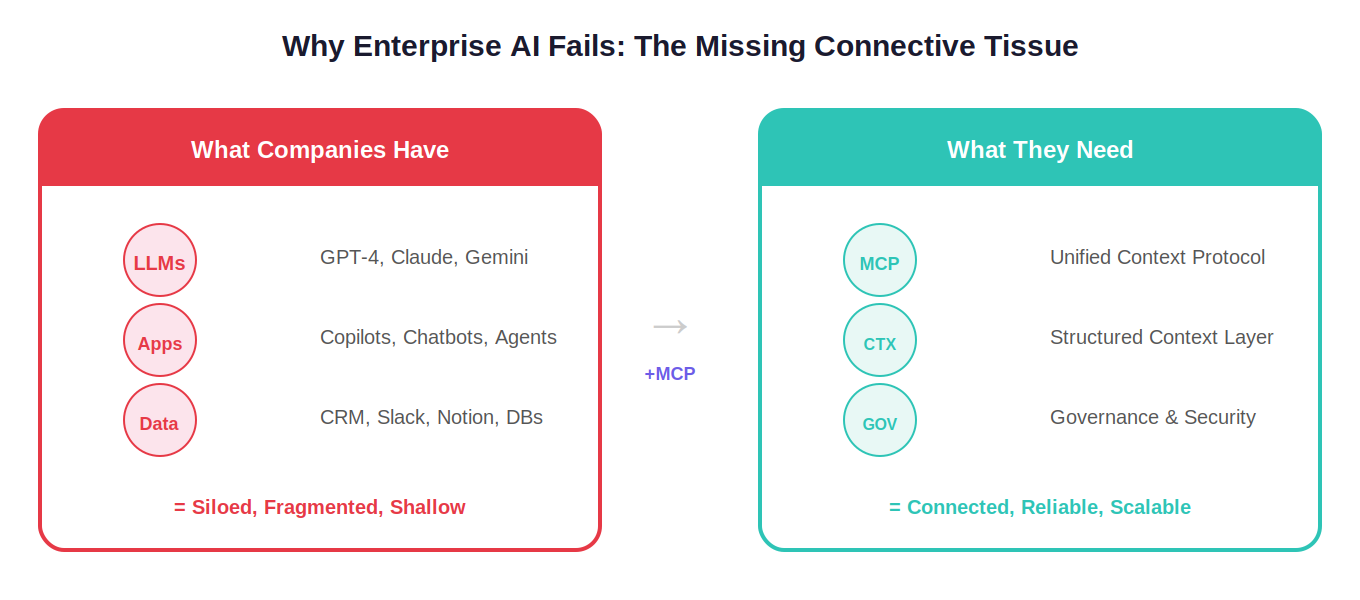
Every B2B company in 2026 faces the same architectural gap. On one side, they have increasingly powerful AI models Claude, GPT-4, Gemini, open-source alternatives capable of sophisticated reasoning, code generation, and decision support. On the other side, they have their actual business data: customer records locked in Salesforce, team conversations scattered across Slack, product specs in Notion, financial data in spreadsheets, and operational knowledge trapped in internal wikis.
Between these two sides? A void. The AI models cannot access the business systems, and the business systems have no standard way to expose their data to AI. This is the B2B AI data integration problem, and it is the single biggest reason enterprise AI pilots fail to scale into production.
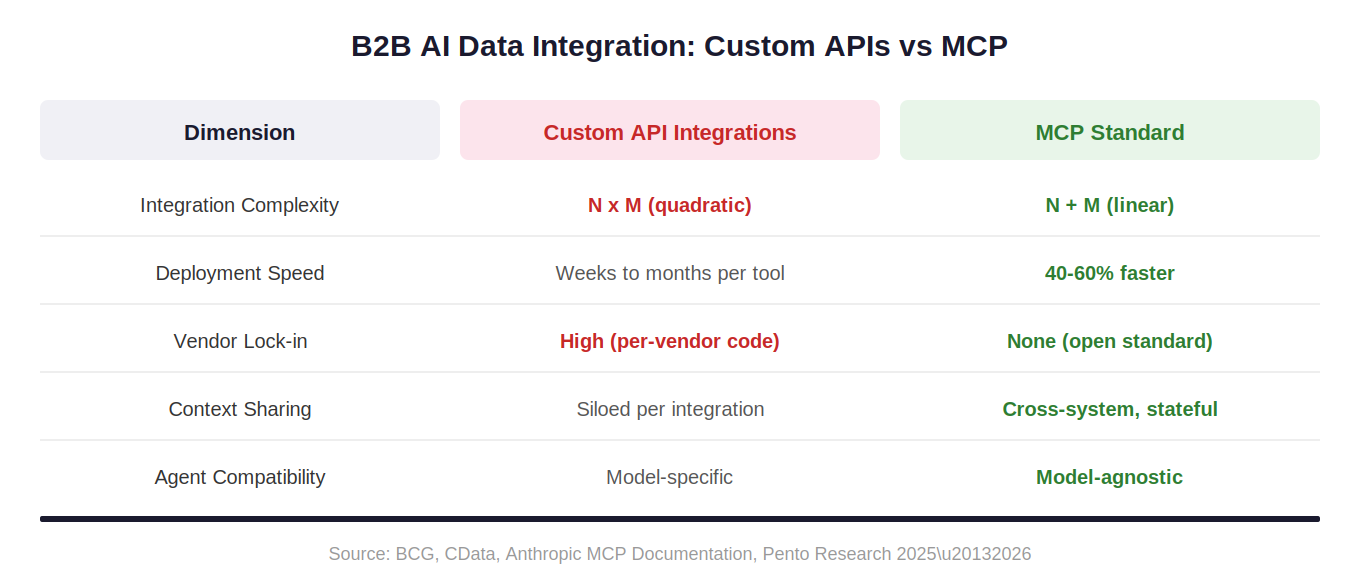
Boston Consulting Group calls this challenge one with "outsized implications." Without a standard integration layer, connecting AI models to enterprise tools creates quadratic complexity: 10 AI applications and 100 tools potentially require 1,000 different custom integrations. Every new tool or model added multiplies the maintenance burden exponentially.
Model Context Protocol (MCP) Guide: What It Is and Why It Matters
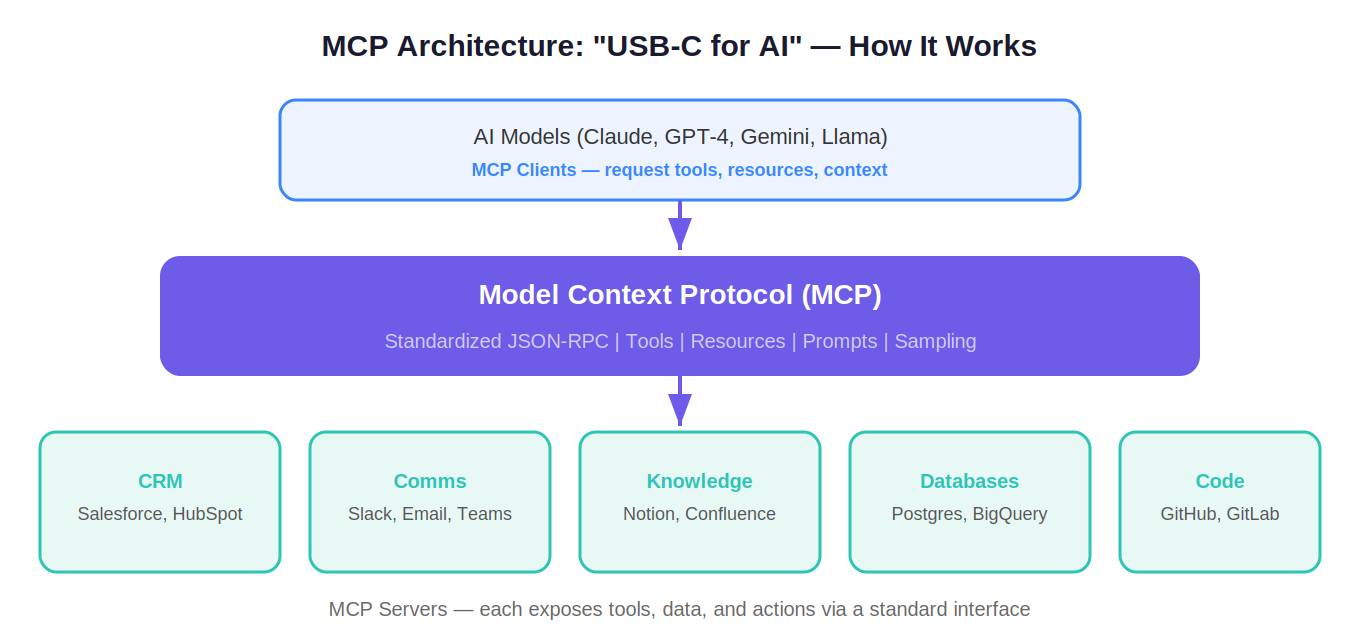
The Model Context Protocol is an open standard introduced by Anthropic in November 2024 to standardize how AI systems integrate with external tools, data sources, and business systems. Think of it as USB-C for AI applications, a universal connector that lets any AI model communicate with any tool through a single, standardized interface.
MCP works through a client-server architecture. AI applications act as MCP clients that request context, while MCP servers wrap individual data sources and tools your CRM, your database, your code repository exposing their capabilities through a standardized JSON-RPC protocol. This means you build one MCP server for Salesforce, and every MCP-compatible AI agent can use it. The N×M integration nightmare collapses to N+M.
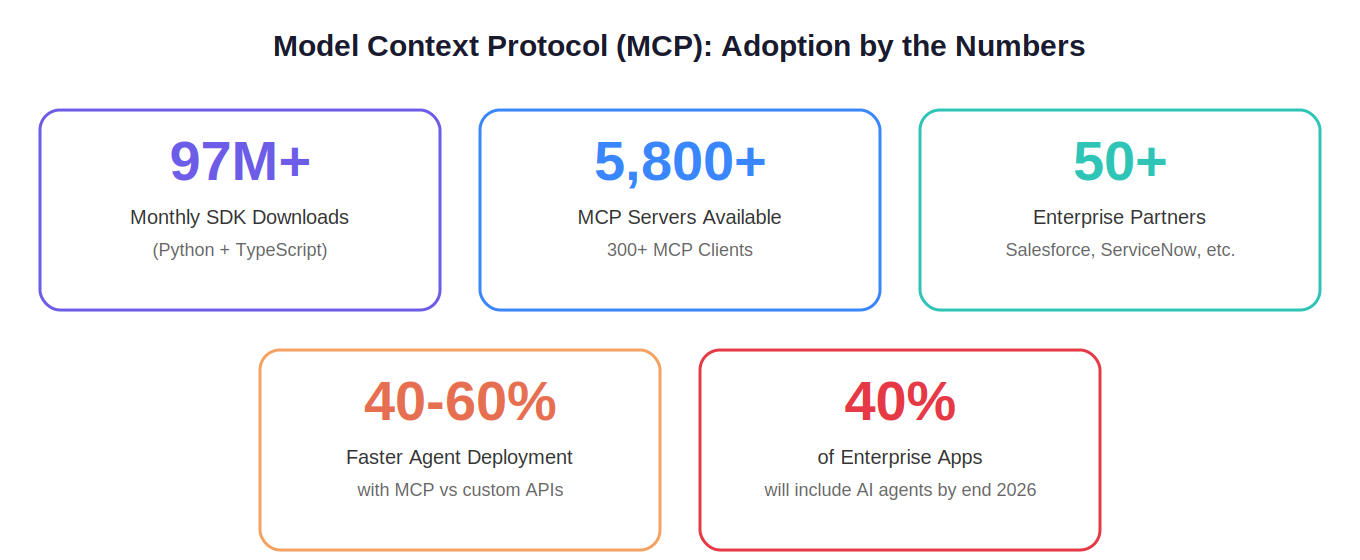
The adoption has been extraordinary. Within a year, every major AI provider including OpenAI, Google DeepMind, and Microsoft adopted MCP. Monthly SDK downloads now exceed 97 million across Python and TypeScript. Over 5,800 MCP servers and 300 MCP clients are available in the ecosystem. More than 50 enterprise partners, including Salesforce, ServiceNow, and Workday, have committed to MCP implementation. In December 2025, Anthropic donated MCP to the Agentic AI Foundation under the Linux Foundation, with OpenAI and Block as co-founders, cementing its status as a vendor-neutral industry standard.
For enterprise leaders evaluating Anthropic MCP for enterprise, the protocol's 2026 roadmap is focused on four priorities: transport scalability for production workloads, agent-to-agent communication, governance maturation, and enterprise readiness including audit trails, SSO-integrated authentication, and gateway patterns.
Why B2B AI Data Integration Breaks Today
Despite MCP's rapid adoption, most B2B companies are still stuck in what we call "context poverty." Their AI implementations fail not because of model limitations but because of fragmented, siloed data that no protocol can magically fix.
The pattern is predictable. A company launches an AI pilot. The pilot works well on demo data. Then it hits production, where it needs to pull real customer history from Salesforce, cross-reference it with support conversations in Zendesk, check the product roadmap in Notion, and understand pricing logic buried in spreadsheets. None of these systems talk to each other, and the AI agent no matter how powerful can only work with what it can see.
Organizations implementing MCP report 40–60% faster agent deployment times compared to custom API integrations. But speed of deployment is meaningless if the agent receives the wrong context, incomplete context, or context structured in ways it can't reason about effectively. This is where most MCP implementations stall: the protocol is live, the servers are connected, but the AI still produces shallow, unreliable outputs because nobody designed the context layer.
Agentic Workflow Architecture: How MCP Enables Multi-Agent Systems
Agentic workflow architecture is the design pattern where autonomous AI agents orchestrate complex, multi-step business processes without human intervention at each step. Instead of a single chatbot answering questions, you have a network of specialized agents: one that monitors customer health scores, another that drafts renewal proposals, a third that schedules follow-up meetings, and a coordinator that sequences their work.
MCP is the connective tissue that makes this architecture viable. Each agent connects to the specific MCP servers it needs the CRM agent connects to Salesforce, the communications agent connects to Slack and email, the analytics agent connects to your data warehouse. Because MCP is stateful, agents can maintain context across multiple interactions and share it with other agents in the workflow. Gartner predicts that 40% of enterprise applications will include task-specific AI agents by the end of 2026, up from less than 5% today. That's an enormous deployment velocity, and it is entirely dependent on standardized integration through protocols like MCP.
But here's what separates functional agentic workflows from the ones that implode: context design. Which data does each agent need? What permissions should it have? How do you prevent one agent from hallucinating based on stale context from another? How do you audit what happened when an autonomous workflow produces an unexpected result? These are context engineering problems, not protocol problems.
The Context Problem: Why MCP Without Context Design Is Just Plumbing
There's a growing consensus among enterprise AI practitioners that the hardest part of building useful AI isn't the model it's connecting the model to everything it needs to be useful, and doing so in a way that's structured, governed, and reliable. This is where the concept of context-first AI strategy becomes critical.
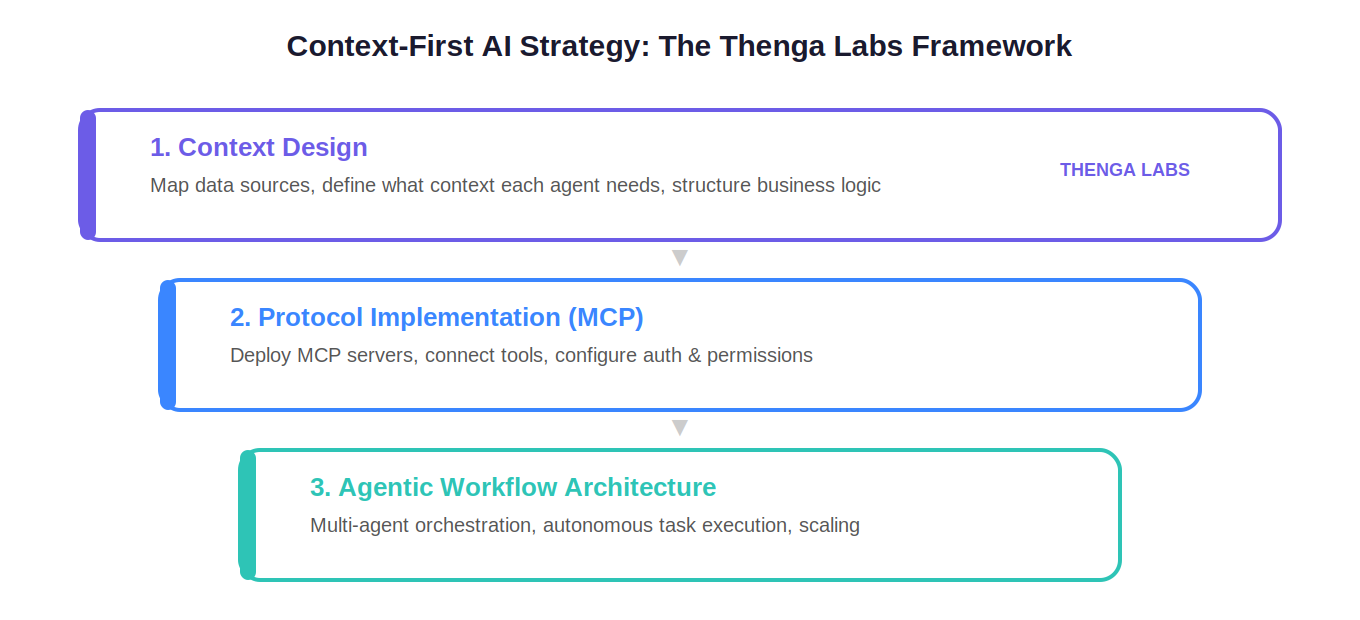
Context design sits above protocol implementation. Before you deploy a single MCP server, you need to answer fundamental questions: What business decisions will these agents support? What data sources contain the context required for those decisions? How should that context be structured, filtered, and prioritized so the AI reasons correctly? What governance and security controls ensure that agents only access what they should?
This is the layer Thenga Labs architects. We define and structure context before MCP implementation mapping data sources to agent needs, designing the semantic relationships between business systems, and building the governance framework that ensures every agent operates within clear boundaries. Without this layer, MCP is just an open pipe. With it, MCP becomes the foundation of a scalable, trustworthy agentic workflow architecture.
Strategic Insights for B2B Founders: How to Get MCP Right
Start with context, not connectors. Before evaluating MCP servers or building integrations, map your business workflows end to end. Identify what context each decision point requires, where that context lives, and how it needs to be structured. Protocol implementation is straightforward. Context architecture is where the real work and the real value lives.
Design for agentic workflows from day one. If your MCP implementation only serves a single chatbot, you've underbuilt. Design your B2B AI data integration layer to support multi-agent orchestration: shared context stores, clear permission boundaries, and audit trails that track which agent accessed which data and why.
Prioritize governance alongside speed. Security researchers have flagged significant risks in MCP deployments over-permissioned tools, prompt injection vulnerabilities, and unauthorized data access through community-built connectors. Less than 4% of MCP-related conference submissions focus on opportunity; the rest focus on risk. Build governance into your architecture from day one, not as an afterthought.
Think protocol-agnostic, context-first. MCP is the leading standard today, but the context layer you design should outlast any single protocol. Structure your business context in a way that's portable, well-documented, and decoupled from specific implementation details. The companies that invest in context engineering will have durable competitive advantages regardless of how the protocol landscape evolves.
The Bottom Line: The Model Context Protocol is the most important infrastructure development in enterprise AI since the transformer architecture itself. It solves the integration problem that has kept AI implementations shallow and fragmented for years. But MCP is a protocol, not a strategy. The companies that win in 2026 will not be the ones that adopt MCP fastest they will be the ones that design their context layer most thoughtfully. Protocol without context is plumbing without water. The future of enterprise AI belongs to the architects of context and that's exactly where Thenga Labs operates.
Published by Thenga Labs